

Quality Management
NSK’s Approach
With quality as one of its core values, the NSK Group aims to become “No. 1 in Total Quality.” In other words, we are working to achieve the industry’s best quality in everything we deliver—not only products and services but also information. We believe that this commitment to quality ensures that our products will satisfy customers all over the world.
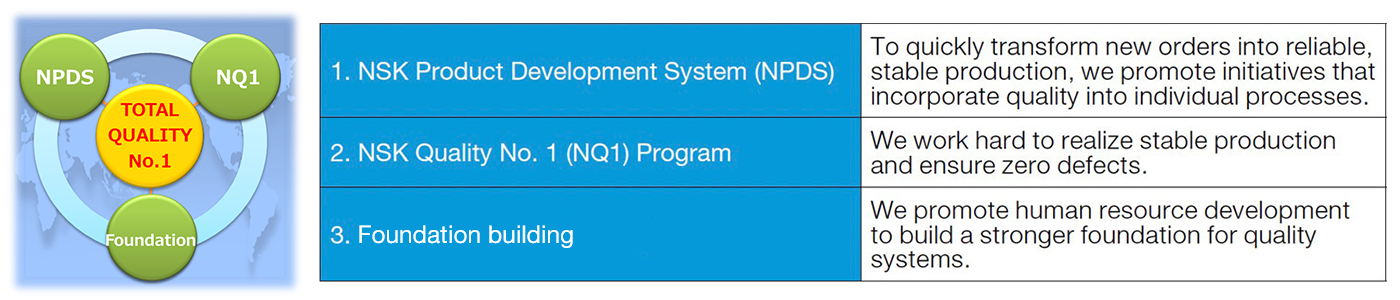
To achieve our Quality Assurance Vision 2036, “Exceeding Expectations Worldwide Through Quality,” we engage in activities based on the Three Pillars of NSK Quality Assurance.
◆Three Pillars of NSK Quality Assurance
◆Quality Assurance Vision 2036
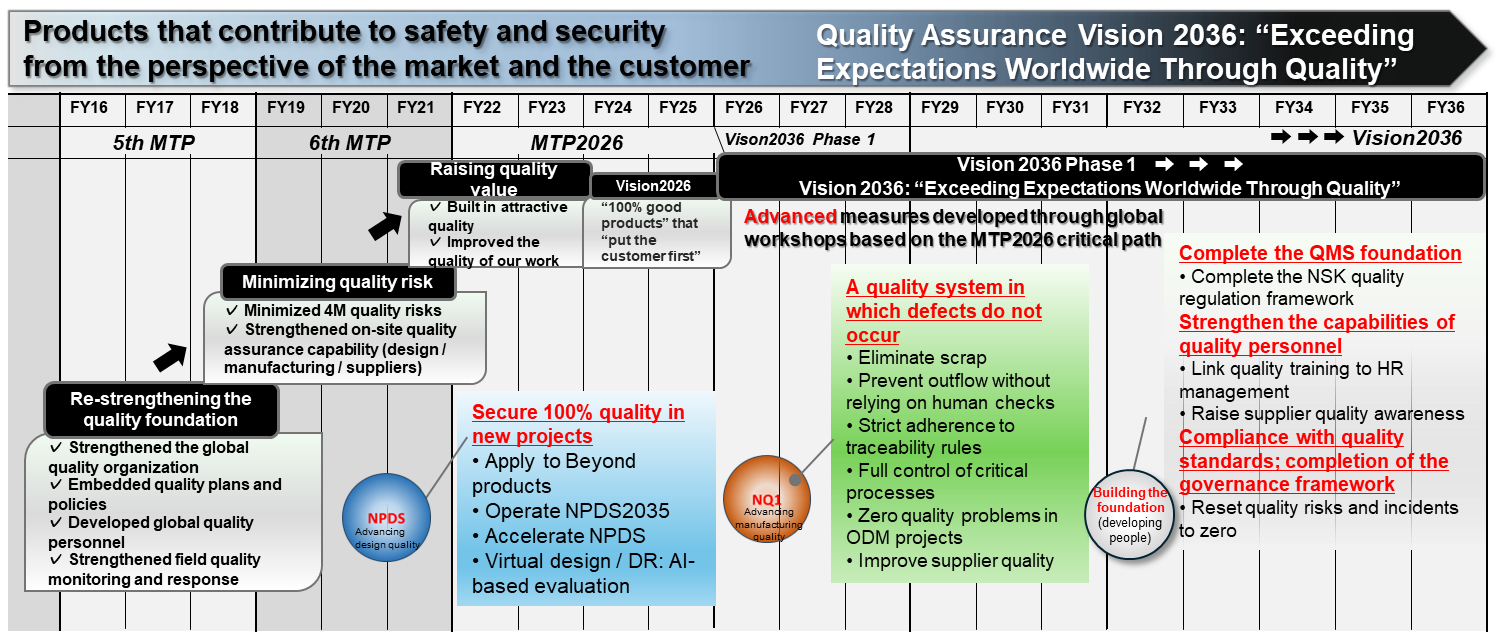
NSK has adopted “Exceeding Expectations Worldwide Through Quality” as the vision for its quality assurance activities through 2036. We aim to transition from activities focused only on product quality assurance to a comprehensive quality management approach that encompasses services, as well.
Our Quality Assurance Vision 2036 defines quality not in terms of how well a product is made, but by the degree to which it meets the needs of society and our customers. The vision is crafted to reinforce NSK’s brand value of “Total Quality No. 1.” We will also continue to pursue the following basic policies in our quality assurance activities.
- Shifting to quality assurance that prioritizes taking the customer’s perspective and meeting the expectations of society
- Promoting quality assurance activities that support the achievement of our quality key goal indicators (KGIs)
- Rolling out activities across three pillars: NPDS (design quality), NQ1 (manufacturing quality), and building the foundation
- Strengthening our global quality assurance structure
- Operating quality risk management and quality improvement activities as a single integrated effort
System
◆Quality Assurance Organizations
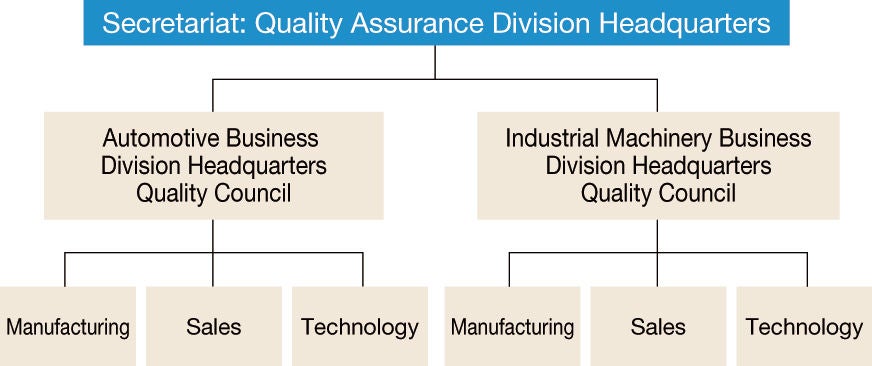
The NSK Group has established the Sustainability & Core Values Committee to promote and strengthen corporate activities based on NSK’s core values (safety, quality, environment, and compliance). To that end, it identifies issues for the entire Group to address by discussing policies and sharing information on related risks. The Committee also provides suggestions for and monitors progress on solutions to these issues.
The Quality Assurance Division Headquarters is positioned as the global headquarters for quality management, and quality councils have been established within each business unit as subordinate organizations of the Sustainability & Core Values Committee. Together, they work to strengthen quality improvement efforts by promoting cooperation among the manufacturing, sales, and technical departments. The headquarters also reports the Group-wide status of quality management to senior management at monthly Officers’ Meeting.
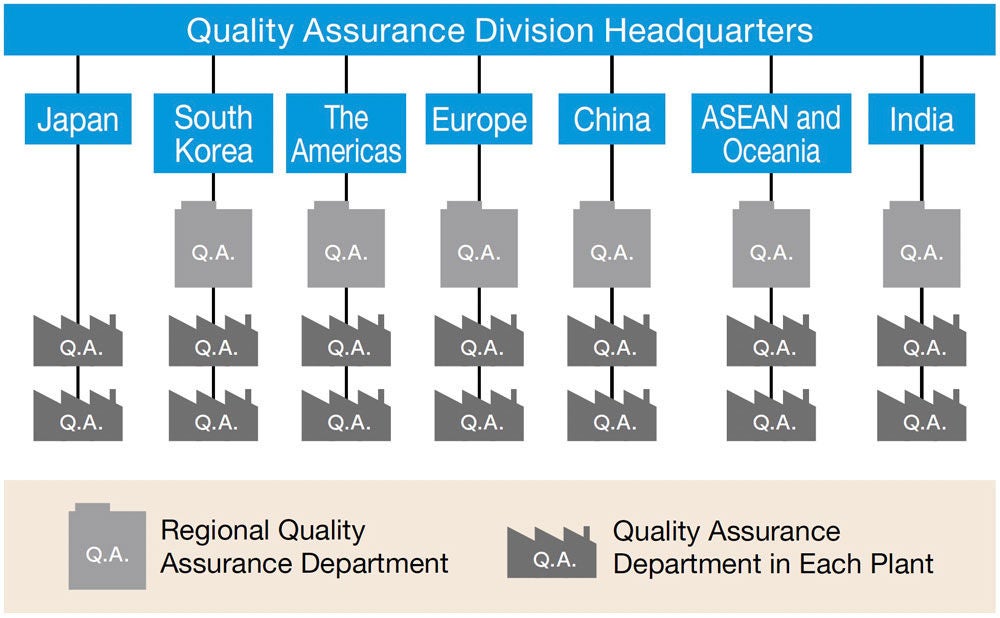
We have established regional quality assurance departments in South Korea, the Americas, Europe, China, ASEAN/Oceania, and India, and tasked them with overseeing quality efforts in their respective regions. This ensures that every region can take the initiative on its own quality activities. It also forms a global quality assurance system that gives the highest priority to meeting customer needs in each country and region.
To strengthen this global collaborative structure, we hold biannual global quality meetings and biannual regional quality meetings, using them to reinforce monitoring, auditing, and support structures in each region.
《Global Collaboration Structure》
- Joint operation with overseas regional quality assurance departments
- Introduction of an overseas champion system for each priority measure (operated jointly with overseas QA)
- Promotion of quality improvement activities by global cross functional teams (CFTs)
NSK Quality Council
Global Quality Assurance Organization
Targets and Achievements
◆Quality Achievements
- FY2023 : 0
- FY2024 : 0
- FY2025 : 0
- FY2026 : 0 (target)
◆Mid-Term Management Plan 2026 (MTP2026) Goals, with Targets and Achievements for Each Fiscal Year
| Pillars | NSK Product Development System (NPDS) NSK’s proprietary quality management system that quickly translates new orders into reliable, stable production | NSK Quality No. 1 (NQ1) ProgramInitiatives to realize stable production and ensure zero defects | Foundation building NSK is promoting the human resource development to build a stronger foundation for quality creation
| |
|---|---|---|---|---|
| MTP2026 | Goals |
|
|
|
| FY2025 | Targets |
|
|
|
| Achievements |
|
|
| |
*1 FMEA: Failure Mode and Effects Analysis, a method for identifying potential failure modes in design and manufacturing, evaluating their impact, and taking steps to address those
◆Mid-Term Management Plan 2028 (MTP2028) Goals, with Targets and Achievements for Each Fiscal Year
| Pillars | NSK Product Development System (NPDS): NSK’s proprietary quality management system that quickly translates new orders into reliable, stable production | NSK Quality No. 1 (NQ1) Program: Initiatives to realize stable production and ensure zero defects | Foundation Building (Developing People) NSK is promoting the human resource development to build a stronger foundation for quality creation | |
|---|---|---|---|---|
| MTP2028 | Goal |
|
|
|
| FY2026 | Target |
|
|
|
Quality Improvement Initiatives
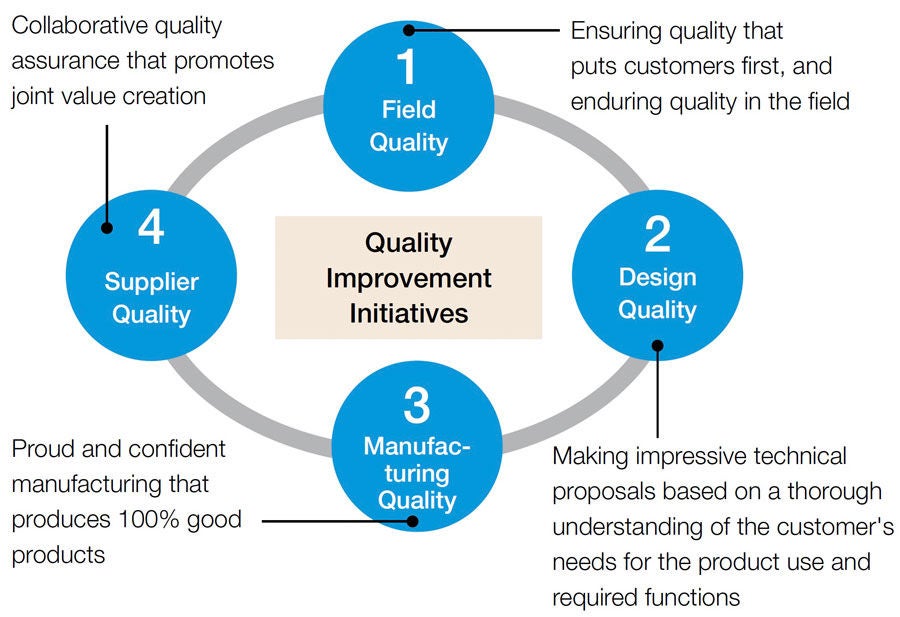
To ensure quality that puts customers first, and enduring quality in the field, the NSK Group strives to secure and improve quality throughout the product process, from design, to procurement from suppliers, to manufacturing. We are promoting total quality through the four initiatives shown below.
◆Initiatives to Enhance Field Quality
As a firm that services the manufacturing sector, the NSK Group aims to achieve a level of quality that meets the expectations of society at large. This is why we not only strive to satisfy our direct customers, but also look beyond to assess the needs of the end users who use products with NSK components. Our system enables us to both propose and deliver quality products and services that thoroughly fulfill both customer and social needs.
Customer Management Database
In order to accurately meet customer requests, the NSK Group provides technical support related to design and expert knowledge on product usage. We have established a database of information such as customer needs, field quality information, and the history of our responses to customer requests. Managing this information centrally allows us to use it to raise customer satisfaction and to prevent field defects before they occur. In addition, we have adopted customer satisfaction as a new quality KGI, so that field assessments feed back into our quality improvement activities. The information gathered from various countries and regions is used to improve our products and services.
◆Initiatives to Enhance Design Quality
The NSK Group incorporates feedback from customers into its designs to enhance quality in the design stage. We make every effort to design products with a superior level of quality by drawing on our expertise and experience in the market, cultivated over many years. We always strive to meet our own unique quality targets, going above and beyond the core quality that our customers have come to expect.
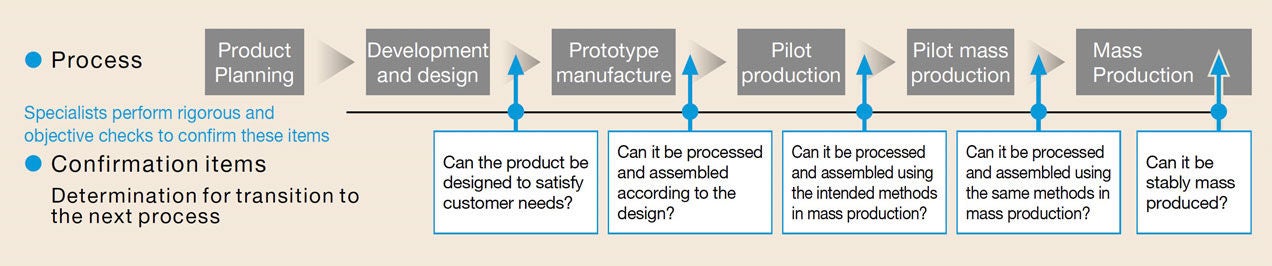
Building Quality into Each Process: NSK Product Development System (NPDS)
With the goal of securing 100% quality in new projects, the NSK Group has globally deployed NPDS, an original quality management system. To respond promptly and reliably to new projects and to mass produce products that satisfy customers, we are working to build quality into the entire development process. At each stage, from product planning to development, design, prototyping, and mass production, we rigorously identify quality risks at the design stage and head them off, working to ensure zero design-related defects. Even after mass production begins, we conduct thorough management to maintain a consistently high level of quality.
Outline of NPDS
Education to Improve the Quality of Design Reviews in Developed Products
To improve product design quality in new projects, the NSK Group has its internal system of experts that perform design reviews (DR) and has implemented worldwide measures to improve DR quality. These DR experts identify issues related to product quality from the design phase and into the mass production phase to prevent problems down the road. Along with the enhancement of DR content for NSK-developed products, we ask these experts to make the most of their knowledge and experience: (1) to promote robust design* proposals that fully meet customer requirements; (2) to build manufacturing processes that emphasize the 4Ms and maintain stable production; and (3) to hand down technology skills while creating learning opportunities for young NSK engineers.
To raise the DR level, the necessary materials and data need to be prepared in advance. When all the participants understand the design details before the DR meeting, the review discussions are more efficient and meaningful. NSK is increasing the number of opportunities for discussions between DR experts and our designers and developers, while working to raise their technical skills and improve the technical data that is needed for each step of the DR process. Moreover, by conducting optimal evaluation and feedback in each step of the DR process, we are working to improve the quality of product development projects as part of our DR quality enhancement efforts.
* Robust design: Design that ensures the required characteristics for various product usage conditions.
Case Study: Quality Assurance in New Product Development
One excellent example of our work to enhance design quality is our filter for slowing the degradation of cooking oil, which we successfully developed for mass production in FY2025. The filter grew out of one of NSK’s core strengths: technology that keeps the lubricating oil in bearings from degrading. Focusing on longer cooking oil life, a challenge recognized across the foodservice market, we applied NSK technology to develop this unique filter. To ensure product quality, we selected materials verified as safe for food applications and conducted oxidation-resistance evaluations. We also validated performance in an extended process of circulating filtration testing. The resulting product extends cooking oil life, reduces waste oil, and lightens operators’ workload. These achievements were recognized with the Nippon Brand Award at the “Cho” Monozukuri Innovative Parts and Components Award.
◆Initiatives to Enhance Manufacturing Quality
The NSK Group works diligently to deliver a consistently high level of product quality that meets customer needs.
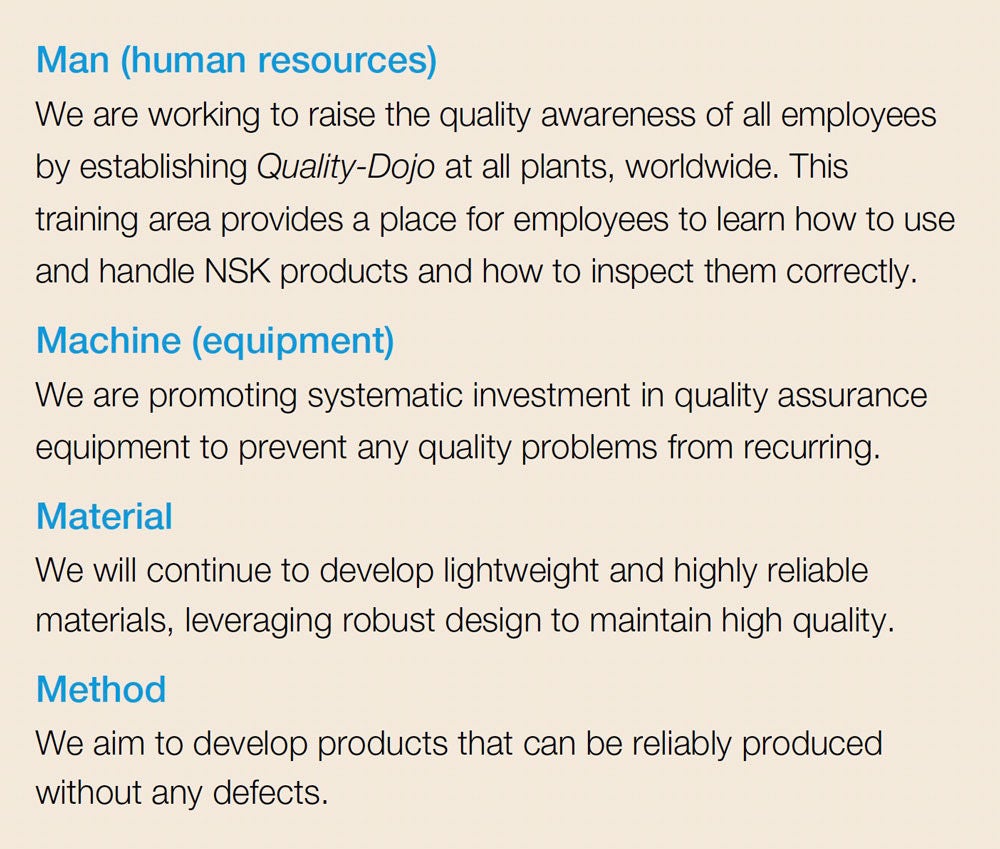
We also develop manufacturing processes that focus on the 4Ms (man, machine, materials and methods) to further improve product quality.
4M Priority Issues
Product Assurance Through Quality Inspection
The NSK Group is committed to ensuring that customers can use its products with total confidence. That is why the Group carries out rigorous product quality assurance using quality inspections, thereby maintaining and strengthening quality control to prevent defective products from ever leaving its plants.
These inspections consist of both visual and functional tests and are conducted at various points of the manufacturing process, from acceptance to shipping, to prevent any defective products from leaving the plant.
We will continue to advance the automation of inspection and, by applying AI to pass/fail evaluation processes, strengthen process assurance and achieve even greater efficiency.
Preventing Quality Defects Through Effective Data Utilization
NSK is working to implement heat treatment cockpit systems across all its plants worldwide. This system enables continual operational status monitoring for heat treatment furnaces. By managing the big data obtained from this monitoring, we aim to prevent heat treatment defects before they occur. IoT connectivity for this equipment is now complete at all plants in Japan, and we have begun accumulating big data and operating the monitoring system. We will next roll it out to our plants outside Japan.
We are also developing an anomaly detection system, the Condition Monitoring System (CMS), to undergird product safety for our customers. The CMS is intended to ensure quality and prevent defects for customers who handle products that pose a high risk in the event of failure and are difficult to maintain or inspect in their operating environment. By detecting vibration during bearing operation and performing vibration diagnostics, the system enables early identification of any abnormality, ensuring that customers can use our products with confidence.
Global Quality Improvement Activities and Their Deployment
Every month, the NSK Group monitors the status of quality management at all production sites worldwide. The NSK Group is engaged in efforts such as zero-defect activities, recurrence prevention activities, and Quality-Dojo activities across all production sites as part of its quality improvement activities. The Quality Assurance Division Headquarters has introduced an award system for each activity, aiming to incentivize active participation. In addition, production sites that have achieved particularly excellent results in terms of quality are designated as outstanding plants, and their characteristics and operational initiatives are analyzed and horizontally deployed to other production sites.
To further strengthen our global structure and encourage regions to take the initiative, we have introduced an overseas champion system for each priority activity. With the role of overseas quality assurance clarified more fully than ever before, we use this system to strengthen collaboration and to drive and roll out improvement activities across global cross functional teams (CFTs).
Quality Training
To promote continuous awareness and knowledge improvement on quality, one of the NSK Group’s core values, the Group provides annual quality training for all employees.
NSK’s quality education program is designed by the Quality Assurance Division Headquarters. Appropriate quality training is conducted as part of group training sessions organized by the Headquarters’ Human Resources Department, NIT,* and other relevant departments, depending on employees' divisions and organizational levels. Moreover, since FY2019, we have been establishing Quality-Dojos at our plants and technical departments, where regular quality training is conducted annually.
《Training includes》
- Rank-based quality training for new employees and managers, tailored for their respective roles and responsibilities
- Quality-Dojo training that allows employees to learn through actual examples and products
- Digital quality training for all employees delivered via e-learning
Function-Based and Rank-Based Quality Education System
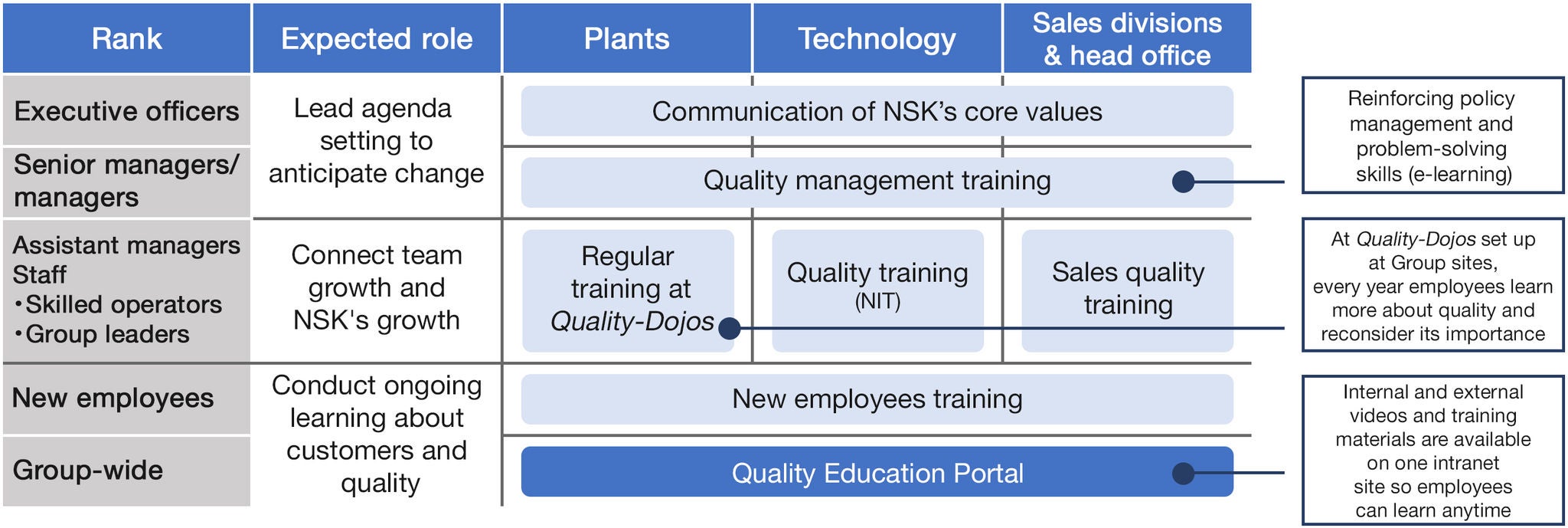
* NIT (NSK Institute of Technology): A faculty-based educational institution with credit-based courses that provides comprehensive technical education on product applications/handling, quality control, manufacturing methods, and cost efficiency. Established in 2007 as an educational center for members of NSK and NSK Group technical departments, NIT aims to develop highly skilled personnel who can support NSK's technological competitiveness.
Quality-Dojo* Training
We believe that quality education should be learned in the order of awareness → knowledge → technique/skill.
To eliminate defects caused by human error, we have established Quality-Dojos at 57 production sites and 8 technology centers worldwide. In these dojos, we foster awareness by explaining the importance of quality, while hands-on experience with actual products and defective items helps employees gain knowledge about products and quality. At our plants, we have continuously promoted Quality-Dojo training over the past five years, aiming to deliver at least two training sessions per person per year. In FY2026, we renewed both our training policy and our targets.
What matters in training is securing both quantity and quality and sustaining both until they become part of the culture. Until now, we have rolled out and established the Quality-Dojo on the principle of quantity × continuity. Under the new policy, we adopt the principle of quality × continuity, giving every employee rank-based training at least once a year. By moving the program from uniform training toward one that is tailored to the role and needs of each level, we will deliver learning that connects directly to everyday work.
We will continue to deliver training that keeps each individual thinking about quality to foster an ever stronger quality culture, so that we can live up to our aim of “No. 1 in Total Quality.” We also assess Quality-Dojo activities at each site objectively through the NSK Quality-Dojo Three-Star Assessment, conducted annually. This does more than confirm results: it pinpoints where further improvement is needed and strengthens the motivation of instructors and assistant instructors to develop their people, driving a continuous rise in the level of our quality training.
* Teachers and assistant instructors will be appointed to all Quality-Dojos to manage them comprehensively, ensuring the enhancement and renewal of educational content to the training of instructors and the formulation of educational curricula.
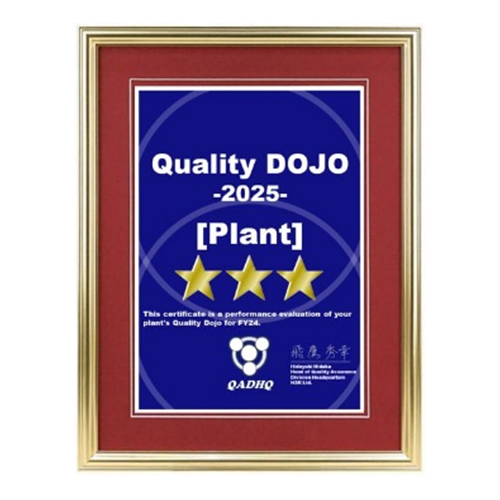
Sample Quality-Dojo Three-Star Assessment certificate
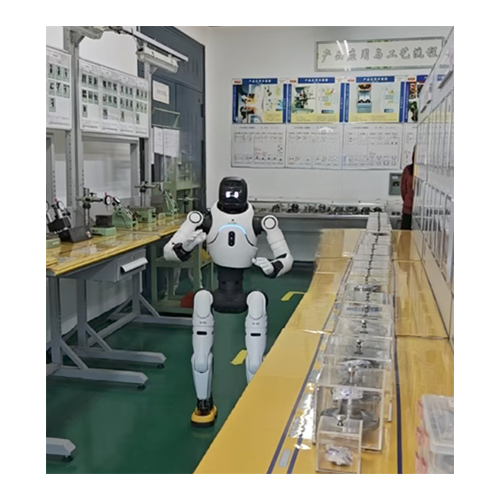
Plant in China: Robot instructor introduced at the Quality-Dojo
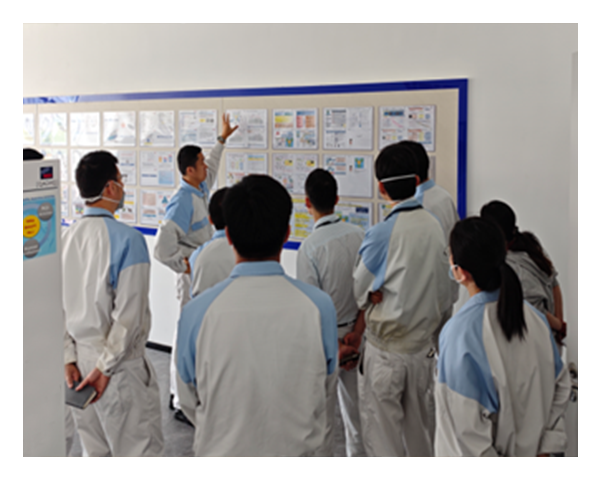
Technology center in China: In-person training
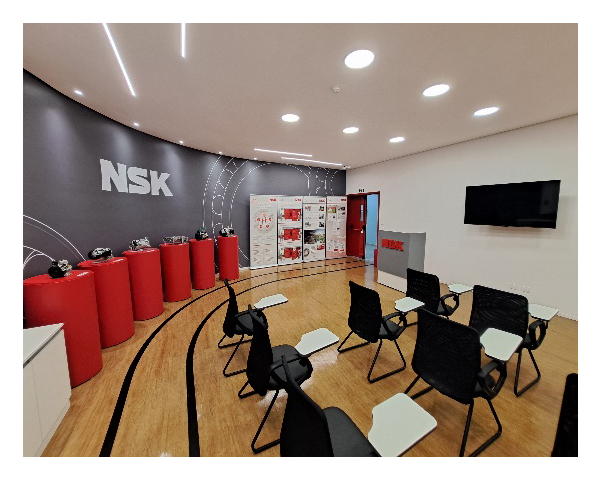
Technology center in Brazil: Quality-Dojo completed in 2026
◆Initiatives to Enhance Supplier Quality
High-quality lubricants, materials, and parts are required to manufacture high-quality products. At the NSK Group, we engage in a wide range of initiatives to enhance quality, based on our strong ties with suppliers. Our Quality Assurance Division Headquarters works to promote quality status data visualization at suppliers, implement improvement plans, and carry out quality improvement efforts, collaborating closely with the NSK plants that receive products.
Main Initiatives
| Policy | Details |
|---|---|
| Supplier briefings on quality activity policy | By providing annual procurement policy briefings for key suppliers, NSK shares its quality activity policies and provides guidance and explanations on quality compliance and quality improvement initiatives In May 2026, 80 companies participated in procurement policy briefings. |
| Ascertaining and visualizing the current quality situations at suppliers | Using trend graphs and radar charts to clarify the situation for quality problems originating at suppliers that are detected during receiving inspections and on production lines |
| Development of a management system for supplier quality problems |
|
| Monthly report on supplier quality issues |
|
| Conducting supplier audits |
|
| QRA* audits of suppliers *Quality Risk Assessment |
|
Activities to Enhance Supplier Quality Awareness
NSK implements supplier Quality-Dojo activities to raise quality capability across the entire supply chain. Each plant selects suppliers to participate based on their importance to the business, quality, and technology, and invites them to the Quality-Dojo. Via practical, hands-on training, we share our quality philosophy and deepen suppliers’ understanding of how supplier quality affects the market and our customers, thereby fostering a quality awareness grounded in the customer’s perspective.
In FY2026, we plan to deliver training to more than 100 suppliers worldwide, working hand-in-hand with our partners to strengthen the quality competitiveness of the entire supply chain.
Other Initiatives
◆Strengthening Audit Functions
The role of the Global Quality Audit Office at the Quality Assurance Division Headquarters is to monitor compliance situations and potential risks relating to quality control, and to implement preventive measures for potential problems. To fulfill this role, the office conducts audits from a third-party perspective. The audit function is more than a monitoring body: it emphasizes working alongside and advising operational sites, encouraging them to improve quality on their own initiative. With auditing, we strengthen both quality governance and continuous improvement.
The audit office also constantly gathers product recall and defect information on other companies. It examines this information and promotes necessary information development and preventive activities.
◆Quality Management System
The NSK Group has obtained ISO 9001 and IATF 16949 certifications, the international standards for quality management systems, at its development, design, and manufacturing facilities. In addition, the effectiveness of our quality management system is verified through periodic third-party and internal audits, and when issues are found, appropriate corrective measures are taken to continually improve the level of our efforts.
◆Response to Product Defects
NSK provides technical information and handling precautions to help customers use its products safely. We have established a framework for receiving and responding to customer requests and concerns. We also have internal rules governing these responses and a cross-departmental structure that allows us to meet the requirements of each country’s laws as well as the specific requirements of our customers.
We do everything we can to ensure quality. In the unlikely event that a product or service defect is discovered, however, we will promptly inform the customer and deploy our quality risk management structure to carry out residual risk management and incident response as a single integrated process in order to prevent recurrence and minimize impact on customers.